At 7 A.M., People Ask AI for the News. Not Google. What Does That Mean for Your Website?
Anthropic's own usage data shows AI chats taking over the role of the search engine: news at 7 a.m., recipes at 6 p.m., and on weekends nearly half of all use is personal. What that means for SMB websites in and around Eindhoven.

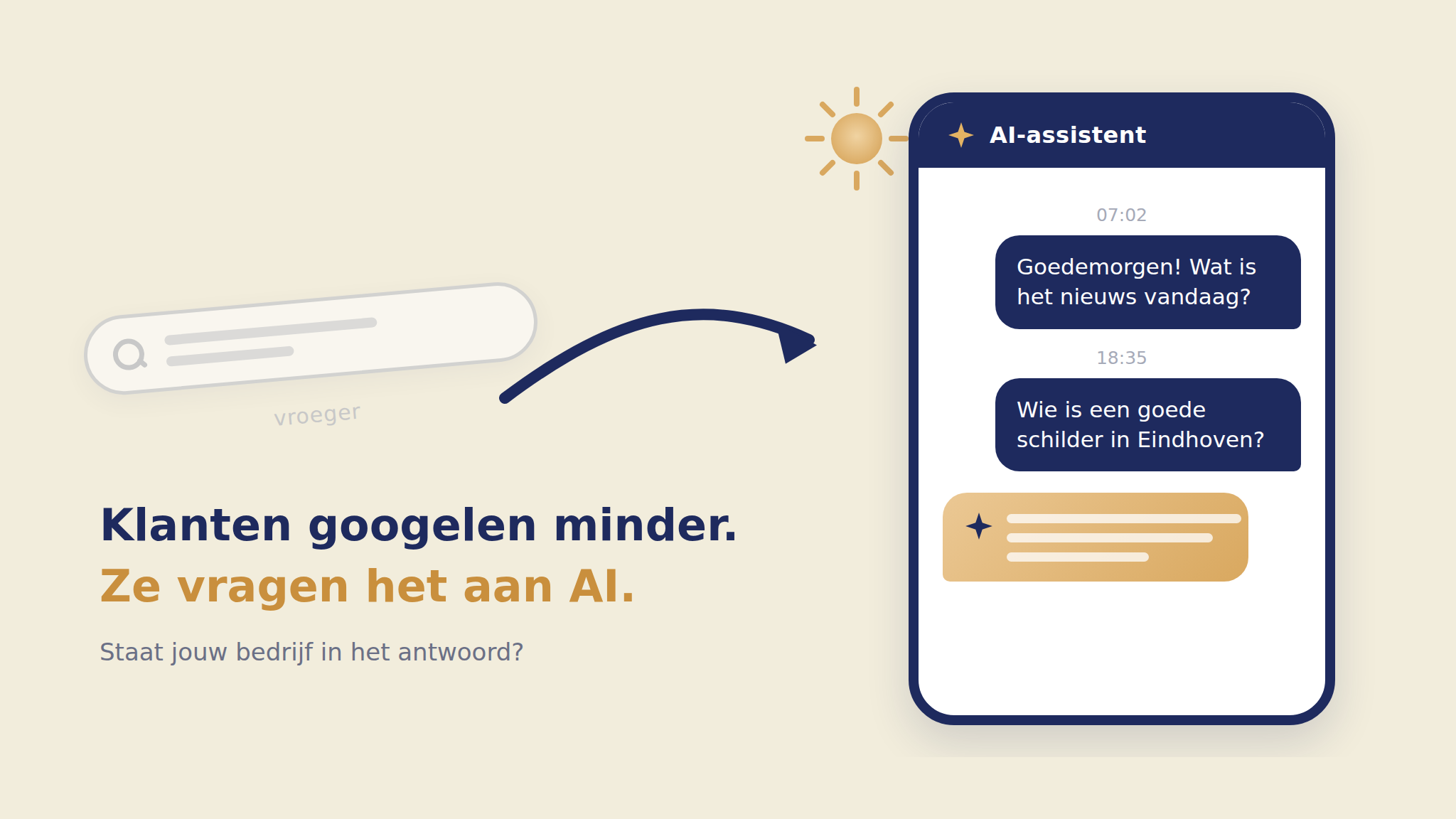
Anthropic looked at its own data, and saw a search engine
In late June, Anthropic (the company behind AI assistant Claude) published the sixth edition of its Economic Index, a recurring study of how millions of people actually use AI. This edition, Cadences, measures for the first time what people ask hour by hour, and links that to a survey of some 9,700 users.
Officially, the report is about work rhythms. But between the lines sits something far more relevant to any business owner:
- At 7 a.m., people ask Claude for the news.
- Around 6 p.m., recipe questions peak, 2.3 times more often than average.
- Around 5 a.m., questions about sleep advice cluster.
- The share of personal use jumps from roughly 35% on weekdays to nearly 50% on weekends.
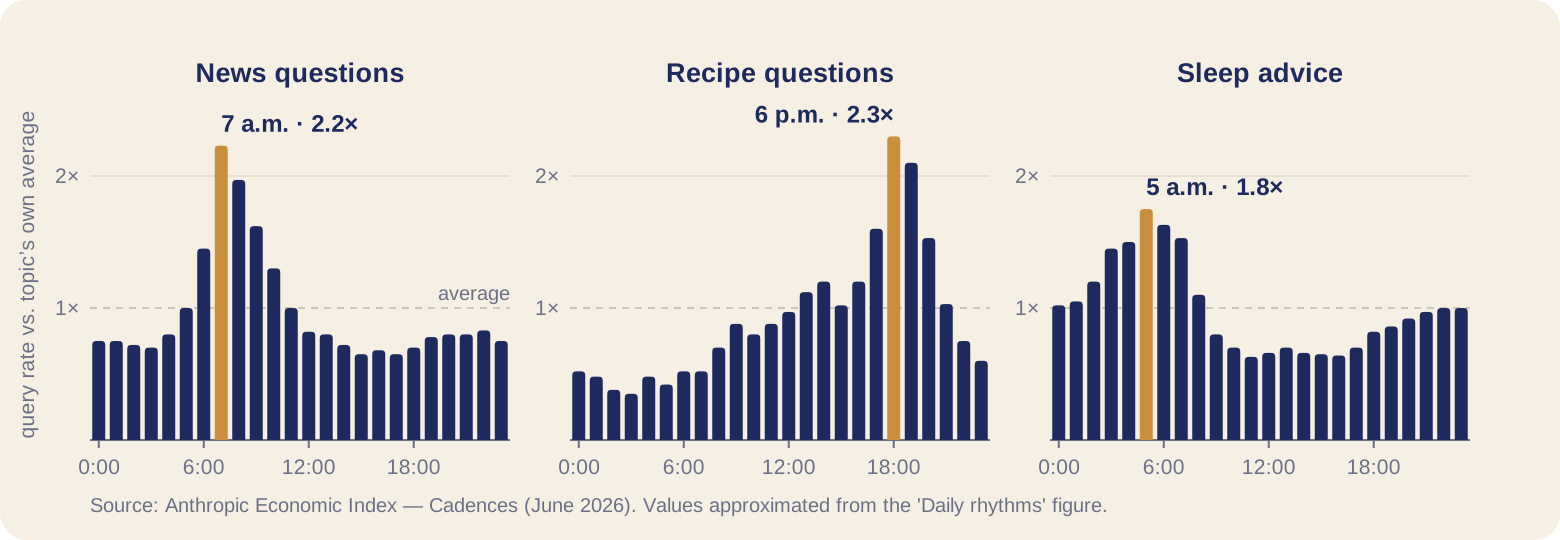
The daily rhythm of three “search” topics in Claude. Recreated after the “Daily rhythms” figure from the Anthropic report; values approximated.
Read that list again. News, recipes, health advice. Those aren’t programmer questions, those are search queries. The questions people typed into Google for ten years, they now put to an AI chat. Anthropic wasn’t even trying to prove that; it simply fell out of their own usage data. That’s exactly what makes the signal so strong.
The bigger picture: the numbers all point the same way
Anthropic’s data doesn’t stand alone. Research into search behavior from 2025 and 2026 paints the same picture:
- Gartner predicted as early as 2024 that classic search engine volume would drop 25% by 2026 as “answer engines” respond to questions directly.
- According to the AI-Search Adoption Survey by Orbit Media, 42% of people prefer an AI chat over a search engine for research that takes multiple steps, and more than half now start a search in an AI app.
- Market figures for 2026 show Google still holds about 90% of the classic search market, but those charts only count the queries that still reach a search engine at all, not the ones a chatbot has already answered.
In short: Google isn’t dead, far from it. But the growth is elsewhere, and it’s precisely the most valuable questions, “who is a reliable…”, “what does … cost”, “who would you recommend for…”, that are moving to AI the fastest.
Why this plays out differently for your business than SEO
With Google, you could sit at position four and still win customers. An AI answer works differently:
There is no page 1 anymore. An AI chat names 3 to 5 businesses, with reasoning. Whoever isn’t in that list simply doesn’t exist for that customer. It’s winner-takes-most.
The customer often doesn’t click through anymore. The answer is the destination. You get mentioned (or not) based on what the AI has been able to read about you, your website is your only voice in that conversation.
An AI mention feels like a recommendation. When ChatGPT says a certain physiotherapist in Eindhoven has a good reputation, that carries more weight than an ad. It’s implicit social proof, free, but only for those who are findable and quotable.
We already saw this mechanism at work when we tested which real estate agents AI recommends (article in Dutch): ChatGPT and Gemini back up their recommendations with reviews, profiles, and, again and again, the business’s own website.
What determines whether AI mentions you?
Whether an AI chat mentions your business comes down to three things you control:
1. Can the AI read your site? AI systems read websites programmatically. Schema.org markup tells them unambiguously who you are, what you do, and where; an llms.txt points them to your key pages. How to add both is covered in our GEO guide for SMBs in Eindhoven.
2. Are there quotable facts on your site? LLMs pick up short, factual claims. “Practice X has treated sports injuries in Eindhoven-Noord since 2015, intake from €45” is quotable; “we stand for quality and personal attention” is not. Transparent pricing in particular makes the difference, we explain why in our article on pricing transparency and AI citations.
3. Does your site answer the question the way the customer asks it? People ask AI chats full, specific questions. A page that answers exactly such a question, “What does a bathroom renovation cost in Eindhoven?”, gets cited more often than ten generic paragraphs. The full playbook is in our GEO guide for SMBs in Eindhoven.
Start now: the advantage goes to the first movers
Most SMBs in the Eindhoven region are doing nothing with this yet. That’s exactly why now is the moment: the businesses that become quotable today will be the names AI chats are used to mentioning tomorrow, and that position is hard to catch up with.
At 7 a.m., someone in Eindhoven asks an AI for the news. At 6 p.m., for a recipe. And somewhere in between, for a painter, an accountant, or a physiotherapist. The only question is whether your name is in that answer.
Curious how your website is doing right now? Request a free scan at siteoptima.nl, we’ll show you what AI chats can currently read from your site and what could be better.
Sources
- Anthropic Economic Index: Cadences (June 2026), hourly usage data and a survey of ~9,700 users
- Gartner: “Search Engine Volume Will Drop 25% by 2026” (February 2024)
- Orbit Media: The AI-Search Adoption Survey
Frequently asked questions
So is Google disappearing entirely?
No. Google still handles by far the most search queries, and many people combine both: research into search behavior shows hybrid journeys, back and forth between Google and an AI chat, already make up about 18% of sessions. But the growth is on the AI side, and the questions asked there are precisely the valuable ones: advice, comparison, recommendation.
How do I know whether AI already mentions my business?
Test it yourself: open ChatGPT, Claude, or Gemini in an incognito window (logged out!) and ask the question the way a customer would, e.g. 'Who is a good physiotherapist in Eindhoven-Noord?'. Repeat it a few times. AI answers vary. If your name isn't there, you have work to do.
What's the difference between SEO and GEO?
SEO targets clicks from Google's search results; GEO (Generative Engine Optimization) targets being mentioned inside an AI chat's answer. The techniques overlap by about 60%, but GEO requires extras: quotable facts, Schema.org markup, an llms.txt, and transparent pricing.
What can I do this week?
Three things: (1) test in an incognito window whether AI chats mention your business, (2) put your key facts, what you do, where, for whom, from what price, on your site as short, factual sentences, and (3) add Schema.org markup and an llms.txt so AI systems can read your site programmatically.
Can SiteOptima do this for me?
Yes. SiteOptima helps SMBs in and around Eindhoven become visible in AI answers as well as in Google, including content creation, technical implementation, and reporting. Request a free scan at siteoptima.nl.
Ready to be found by AI?
SiteOptima helps SMBs in and around Eindhoven become visible in Google and in ChatGPT, Gemini, and Claude. Start with a free audit.
Start free audit →