One check says nothing: how often does AI really name you?
You ask ChatGPT once about your trade and your town. Your name comes up or it does not. That one time tells you little. For one practice we asked the same questions every week for two months: the same question gave anything between 25 and 100 percent. And a conclusion we nearly published ourselves fell apart when we looked closer.
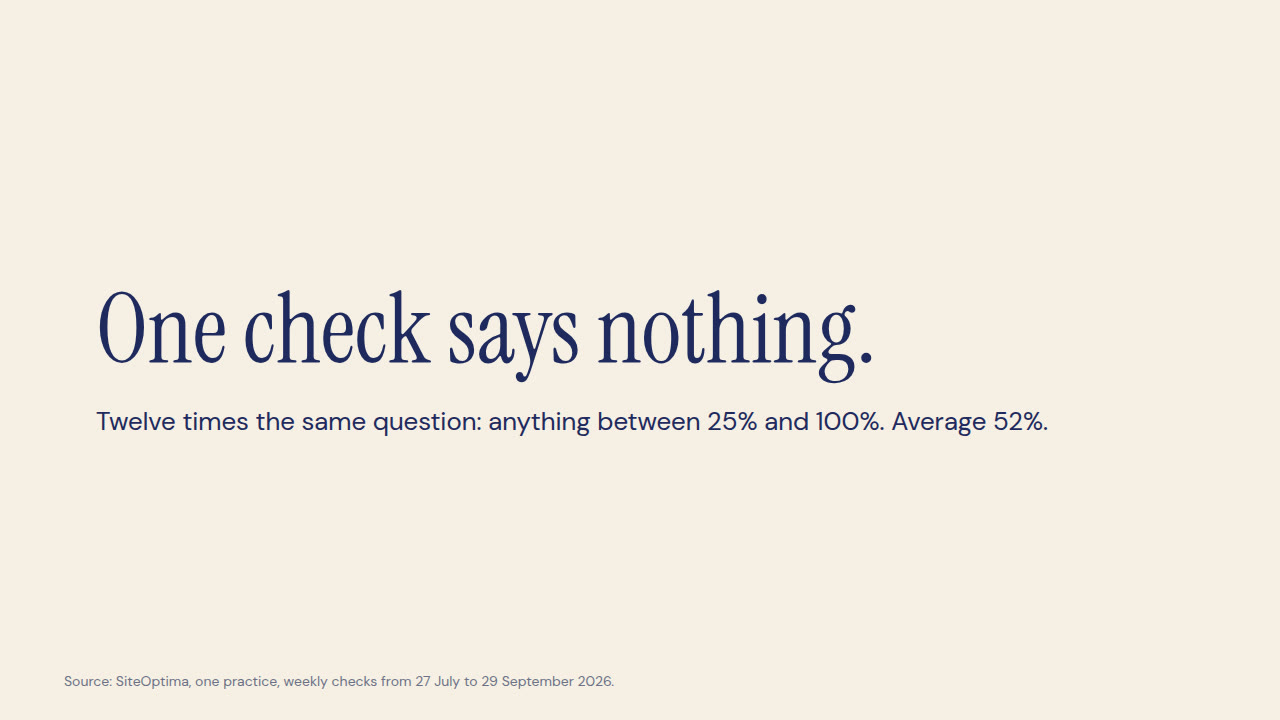
You asked once
You open ChatGPT, ask who the best in your trade is in your town and look for your name. If it is there, you are reassured. If it is not, you worry.
Both reactions come too early. We found that out in our own measurements. It nearly cost us a wrong conclusion.
The same question, twelve different days
For an optician in a village near Eindhoven, we have asked three or four AI assistants the same four questions every week since late July. For each check we count which share of the assistants names the practice. Same practice, same website, same weeks.
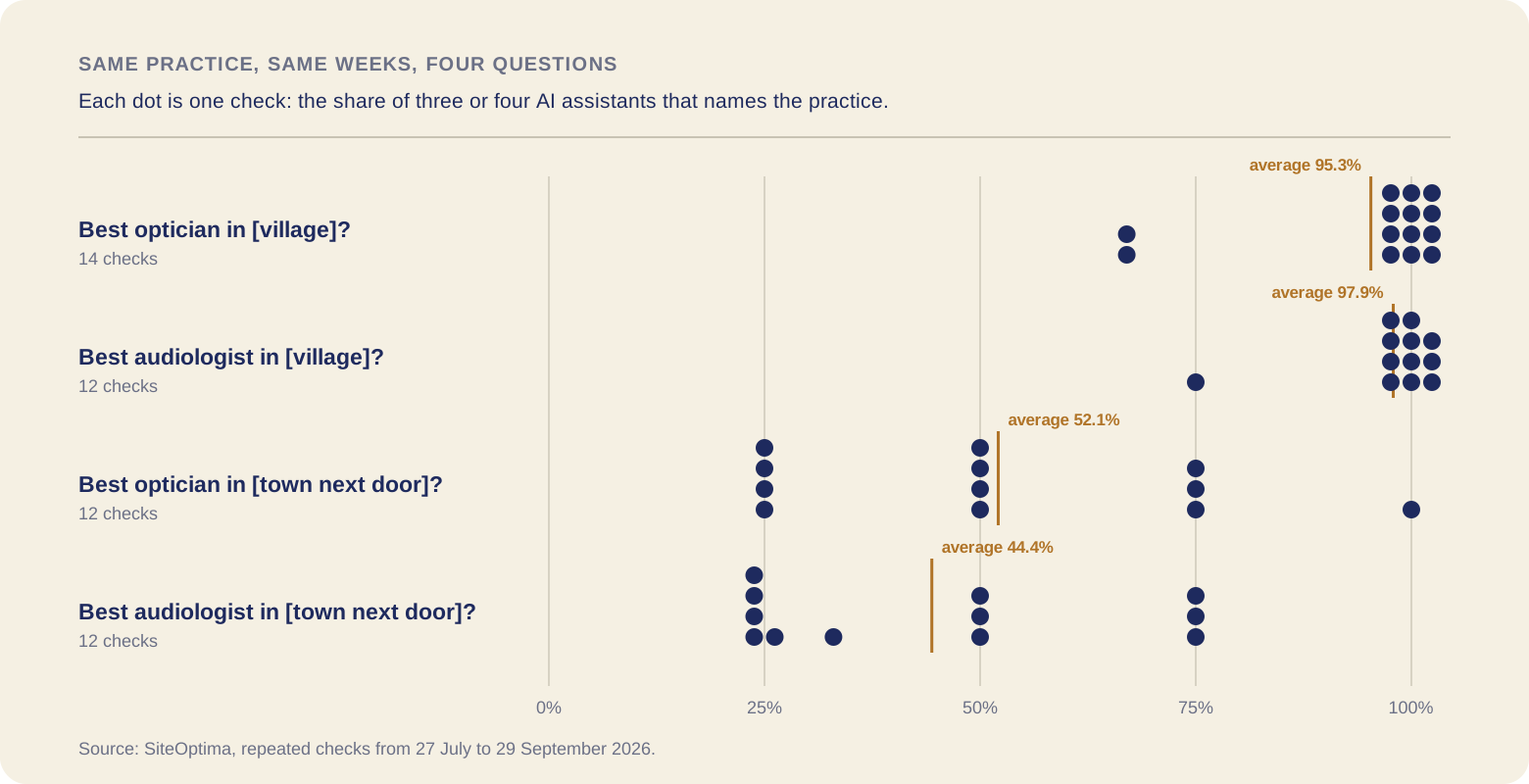
Look at the third row. Twelve times the same question about the town next to the village. Four times a quarter of the assistants named the practice, four times half, three times three quarters and once all of them.
Had you measured once, you could have written down 25 percent or 100 percent. Both true for that one day. Both a wrong picture of where it really stands.
The question decides the answer
Now compare the top two rows with the bottom two. Asked about its own village, AI names the practice almost always: on average 95 and 98 percent. Asked about the town next door, on average 52 and 44 percent.
That is the same website. The difference is in the question. In the village this practice is one of few. In the town next door there are more. There an assistant more often picks someone else.
So the question “am I named?” has no answer. “Am I named when someone asks about my trade in this town?” does.
The assistant matters too
Since late July, Perplexity named the practice in 82 percent of checks, Gemini in 78 percent, ChatGPT in 73 percent and Claude in 56 percent. Trying only ChatGPT shows you one of the four.
How we nearly fooled ourselves
In September we put two things side by side for 19 businesses: how their website scores and how often AI names them. The difference looked large. The businesses with the best score for AI readability were named more than twice as often as the rest. We wrote a piece about it.
That piece is not online. When we recalculated it with the current version of our measurement, nothing was left of it: the top half was named in 33.6 percent of checks and the bottom half in 33.5 percent. The SEO score did not predict it either.
The cause is what you saw above. For 14 of those 19 businesses we had exactly one check. With three assistants, one check can only give 0, 33, 67 or 100 percent. With numbers that loose you can find any relationship you look for. At the next measurement it is gone again.
We also made mistakes in the questions themselves. In the first weeks the full address of the practice was in the question, so the assistant named the practice by default. Twice our system asked “best business in Eindhoven?” because of a bug, and the result was 0 percent. Both say nothing about the practice and everything about the measurement.
What to do with a percentage
If anyone gives you a percentage for how often AI names you, us included, ask four questions:
- How often was it measured? Once is a snapshot. Only over several weeks do you see where it really sits.
- With which questions, exactly? The town and the trade in the question make the difference between 44 and 98 percent.
- On which assistants? For this practice the assistants were 26 percentage points apart.
- What did the question look like? If your address or business name is already in it, you are measuring nothing.
If someone cannot answer that, the number is not a measurement.
What this does not show
This is one practice, in one region, over two months. For another business, with other competitors, the numbers can look very different. What does not depend on that is the pattern: the same question does not give the same answer every time.
We measure through the interfaces the makers offer for software, with fixed models. In the app on your phone an assistant can answer differently, for instance because it searches the web there. There too, the answer changes from one time to the next.
Your own baseline
If you want to know how often AI names you, we measure it with fixed questions about your own trade and town, on several assistants, repeated over several weeks. Then you have a number that means something. You also see which question it goes wrong on.
Book an analysis or a short call.
Source: SiteOptima, repeated checks at one practice from 27 July to 29 September 2026. The comparison of 19 businesses comes from the measurement with GEO score version 3 of 2 October 2026.
Frequently asked questions
How often do you need to measure before a percentage means something?
We do not give a hard number, because it depends on how much the answers vary. What we do see: for the questions where the practice is almost always named, a few checks show where it sits. For the questions around 50 percent, every single check jumps around and you need ten or more to trust the average. That is why we measure weekly with fixed questions.
Why do the assistants differ so much?
They use different sources and weigh them differently. Since late July, Perplexity named this practice in 82 percent of checks, Gemini in 78, ChatGPT in 73 and Claude in 56 percent. Testing on one assistant shows only part of the picture.
Is this the same as what I see in the ChatGPT app?
Not exactly. We measure through the interfaces the makers offer for software, and that is not always the same model or the same search feature as the app on your phone. The point of this article still stands: in the app the answer also changes from one time to the next, so trying once there tells you little too.
What should I ask an agency that quotes a percentage?
Four things: how often was it measured, with which questions exactly, on which assistants and over what period. If you get no answer to that, you do not know whether the number is a measurement or a lucky draw.
Can I test this myself?
Yes, if you do it often enough. Ask the same question, the way a customer would, at several moments and in several assistants, in a clean session without an account. Write down each time whether you are named. After a few weeks you know more than after one try. You also see which question makes the difference.
Ready to be found by AI?
SiteOptima helps SMBs in and around Eindhoven become visible in Google and in ChatGPT, Gemini, and Claude. Start with a free audit.
Start free audit →