I Can't Write. This Article Is Still Mine.
You used to hire a copywriter and nobody called it slop. I use AI to do exactly the same thing: my material, my judgement, someone else doing the writing. Why "was this written by AI?" is the wrong question, and which question you should be asking about the text on your site.


For fifteen years it stayed in my head
I’m not a writer. That isn’t modesty, it’s just true. I read a lot, articles, newsletters, videos about my field, and I usually have a firm opinion about it. What I can’t do is turn that into something anyone wants to read. Sentences that flow, a structure that holds, the word that is exactly the right one: that’s a craft, and it isn’t mine.
I’m journalistic rather than literary. I gather, I connect things, and I work out fairly quickly what’s a story and what’s noise. But writing it down was always the bottleneck. So most of it stayed in my head, or in a folder of bookmarks I never opened again.
That used to have a solution, and the solution was called a copywriter. A company with a budget told a writer what it had to say, and the writer made it readable. The idea belonged to the owner, the phrasing to the writer, and the owner’s name went underneath.
Nobody called that slop.
That is exactly what I do now, only without an invoice. I supply my material, what I’ve read, what I think of it, which numbers I pull from our own scans, and have it written up. The division of labour is identical to the one from fifteen years ago. Only the copywriter has changed.
So what is the actual problem here? Should publishing be reserved for people who happen to be good with words?
So what is slop, then?
Since “this is AI slop” became a default reaction online, the discussion has been almost entirely about origin. Someone recognises a certain sentence shape, spots one em dash too many, and scrolls on. The text has been dismissed before anyone asked whether it said anything.
Two very different things get conflated in the process.
The first is value: text with nothing of the maker in it, where the machine has filled the space with what it would say to anyone. The second is texture: the phrasings every model overuses, the rhythm that becomes recognisable after a while. The overwhelming majority of slop accusations are about the second, on sight, while the first is the only one that actually costs a reader anything.
And that first one is older than the chatbots. Anyone searching the web ten or fifteen years ago ran into exactly the same thing: pages full of text about nothing, the same search term crammed fifteen times into one paragraph, entire websites that existed to rank rather than to be read. That was written by hand, by people, paid by the piece. It was called keyword stuffing, content farms, or simply “SEO copy”.
No AI was involved, because it didn’t exist yet. Yet it is exactly the same product: volume with no substance, made for an algorithm instead of a reader.
So slop is not an AI invention. AI only made it cheaper, and with that, “who wrote this?” became worthless as a judgement of quality.
Google itself says origin doesn’t count
This isn’t a matter of interpretation. Google wrote it down in March 2024 in its own spam policies, under scaled content abuse. The core of it: the policy applies regardless of whether content is produced through automation, through humans, or a combination of both.
And in its guidance on AI-generated content Google is equally direct: what matters is the quality of the content, not how it was produced. Using AI to make useful content is fine. Using AI to manipulate rankings is not, exactly as was the case for human work.
So the question is not who or what wrote the text. The question is what it was written for: to get someone further, or to grab a position.
For AI search, vague copy costs you twice
This is where it gets concrete for your business, because something has changed since the content-farm era.
Back then it was ten blue links. A mediocre page could sit at position seven and still bring in visitors. Ask ChatGPT or Gemini now, “who’s a good installer in Eindhoven?”, and three to five names come back. That’s it.
An answer like that is assembled from short, factual statements the system can lift from websites. And that is where generic copy falls apart:
- “We stand for quality, craftsmanship and personal attention”, there is nothing here to cite. Not a single fact in it.
- “We have been installing heat pumps in Eindhoven and the surrounding area since 2011, with a no-obligation home survey from €0”, an AI can lift this verbatim, and does.
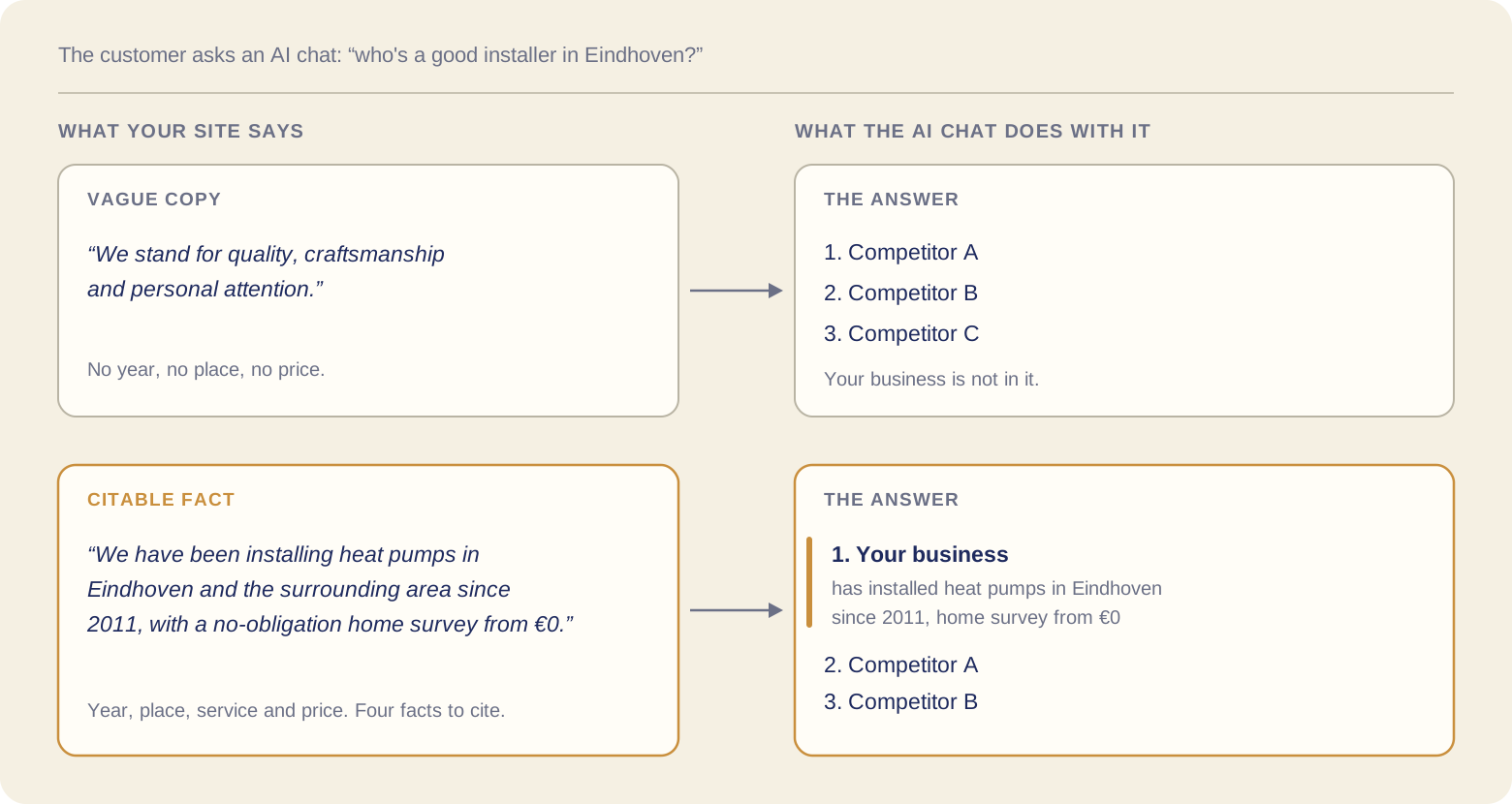
Same question, same website, one sentence different. What the AI chat carries over is the fact that is there. An illustration of the mechanism, not a measurement.
The difference isn’t in the writing style, and it isn’t in who typed the sentence. It’s in whether there is something in it that only this company could have said.
We see this constantly in our scans. Per page we measure, among other things, the word count, whether there are recognisable unique selling points, and whether the tone is consistent across the site. A 120-word service page without a single concrete detail scores badly on all three, and that isn’t a style issue: there simply isn’t enough information for anyone to make a decision. Our guideline is 400+ words on a service page and 500+ on a homepage, with at least one checkable fact per section.
The mirror test
The most useful check you can run yourself takes thirty seconds.
Take a paragraph from your own website. Ask yourself: could this paragraph sit exactly as it is on my closest competitor’s site, with only a different company name in it?
If the answer is yes, there is nothing of you in it. No number of your own, no method of your own, no example of your own, no price. In that case it genuinely doesn’t matter whether a human or a machine wrote it, because neither put anything into it.
That is also why “have AI write something about my company” so often disappoints. If the model knows nothing about you, it fills the space with what it would say about anyone. Not because it writes badly, but because nothing was supplied to write about.
It works just as well in reverse, and that’s where I sit myself. Someone who knows their trade inside out but hates writing already has the scarce part. The analysis, the judgement, the examples from practice: that’s the hard bit. The phrasing is the easy bit. Spend ten minutes talking through what you actually think and have it organised, and you get your own story back. Type “write a blog about heat pumps” and you get everyone’s.
How this article was made
It would be strange to argue this and stay vague about it, so: this article was written with AI, and this is how.
Everything I read or watch and find interesting gets forwarded to a single address. It lands in an archive where every source is stored in the same shape, with a reference to exactly where something was said. This article started with a newsletter from the American writer Alex McFarland, who describes producing slop for a horse-racing site long before the models existed: copying out results, keywords in, twelve to twenty dollars a piece.
Every claim from a source like that is then checked against what we actually do and measure, and gets a verdict: do we already cover this, is it new, or is it wrong? For this one piece that produced ten recorded verdicts.
One of them is the reason you didn’t read a particular claim above. McFarland builds his argument on the assertion that the dictionary Merriam-Webster made “slop” its 2025 word of the year without mentioning AI in the definition. That isn’t right: the definition does mention artificial intelligence. It is precisely the sentence his argument rests on, and it is incorrect. So that framing isn’t used here.
That’s the kind of check a model doesn’t run on its own. It is also exactly what I mean by “there has to be something of yourself in it”: not that you type every sentence by hand, but that you decide what the machine looks at, what it has to verify, and what you refuse to publish.
For articles we produce for clients there are hard rules on top of that: no invented percentages or statistics, no attribution to a body like the CBS unless the claim is actually there, and no invented addresses, phone numbers or customer stories. That last one sounds obvious, but it is exactly where things go wrong: an invented figure ends up on a client’s own site, under their name. And nothing goes live until the client has read and approved it.
This is becoming more explicit outside our field too. The European AI Act has carried transparency obligations for AI-generated content since August 2026, with an exception where a human holds editorial responsibility for publication. That rule targets text informing the public on matters of public interest, so a commercial business blog probably falls outside it. And since August 2026 Anthropic marks the text its newer Claude models generate in a machine-readable way.
That’s not a reason to avoid AI. It’s a reason to know what appears under your name.
Three things you can do this week
1. Run the mirror test on your most important page. Usually that’s the homepage or your busiest service page. Strike out every sentence that would sit just as comfortably on a competitor’s site. What’s left is what genuinely sets you apart. If that’s not much, you now know where the work is.
2. Replace one vague claim with one checkable fact. How long you’ve been in business. What a project costs, or the price it starts from. Which towns you work in. How long something takes. This is the same change that improves your odds of being mentioned in AI answers, and why pricing information carries so much weight is covered in our article on pricing transparency and AI citations.
3. Decide who signs off. However a text comes into being: one person reads it before publication and stands behind it. That is the cheapest quality measure there is, and the only one that protects against both invented figures and text that says nothing.
If you want AI chats to start naming your business, the broader approach is in our GEO guide for SMBs in Eindhoven.
In closing
The debate about AI slop is almost always about origin, while origin is the one thing neither Google, nor an AI answer, nor your customer rewards. What does get rewarded is text with something in it that only you could have said.
That was true fifteen years ago, when slop was still written by hand. It is still true today.
The difference is that a lot of people can now take part who were previously shut out. Skilled people who know exactly how something works and have never been able to write it down. I’m one of them. I don’t think publishing should be reserved for those who happen to be good with words. I think you should have something to say.
Curious how your copy stands up? Request a free scan at siteoptima.nl, we show what AI chats can currently read from your site, which pages have too little substance, and where the quickest wins are.
Sources
- Spam Policies for Google Web Search, scaled content abuse, policy applies regardless of whether automation or humans are involved (March 2024)
- Google Search’s Guidance on Generative AI Content, quality counts, not the production method
- Merriam-Webster’s 2025 word of the year: “slop” (announced 14 December 2025)
- Alex McFarland, “I was writing slop before AI existed”, WriterOps (21 August 2026), the starting point for this article
- EU AI Act, Article 50, transparency obligations, applicable since 2 August 2026
- How Claude marks AI-generated content. Anthropic on marking text generated by Claude
Frequently asked questions
Am I allowed to have AI write my website copy?
Yes. Google states plainly that what matters is the quality of the content, not how it was produced, and that using AI to make useful content is fine. What does work against you is text produced at scale to influence rankings rather than to help a reader. That applied just as strictly to human-assembled text before AI existed.
Am I being lazy if I let AI write my copy?
No more than a business owner who used to hire a copywriter. The question is what you supply. Supply your own experience, your own numbers and your own judgement, and the result is yours. Type "write a blog about heat pumps" and you get what everyone gets, that isn't laziness, it's a missed opportunity.
Can an AI detector prove my text was made by AI?
Detectors give a probability, not proof, and they get it wrong in both directions: carefully written human text is regularly flagged as AI, and the reverse happens too. More importantly, it isn't what your customer or Google is steering on. Since August 2026 some AI providers do mark their own output in a machine-readable way, which is a very different thing from a detector guessing.
What exactly is the mirror test?
Take a paragraph from your own site and ask whether that same paragraph, with only a different company name, could also sit on your competitor's site. If so, the text contains nothing only you could have written: no number of your own, no method of your own, no example of your own. That is precisely what a reader and an AI answer both skip past.
What should I do if my site is full of vague copy?
Start small: on your most important page, replace one vague claim with one checkable fact, how long you've been in business, what a service costs, which towns you work in, how long a project takes. That is immediately the kind of text AI chats can cite. If you want to know where your site stands today, request a free scan at siteoptima.nl.
Ready to be found by AI?
SiteOptima helps SMBs in and around Eindhoven become visible in Google and in ChatGPT, Gemini, and Claude. Start with a free audit.
Start free audit →