What is SEO? A client bought links and never knew what they did
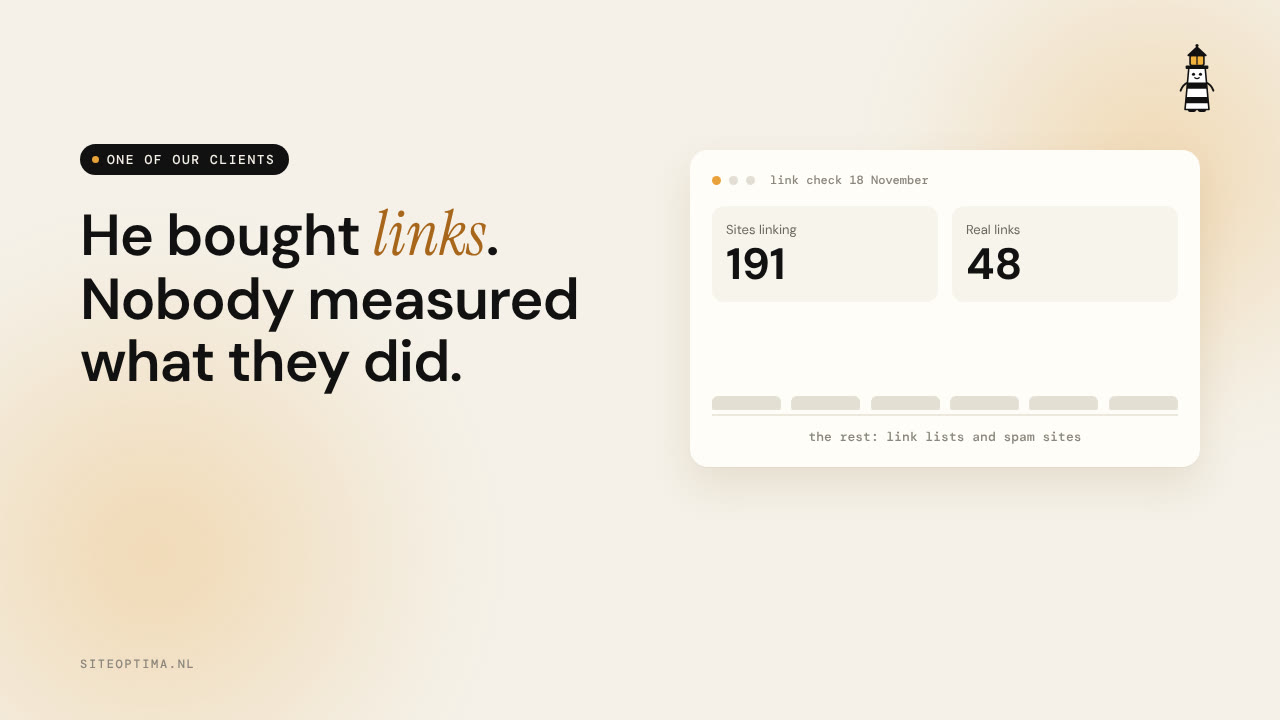
SEO stands for Search Engine Optimization: setting up your site so Google finds and shows it. But SEO is not a one-off job you buy. A client in our region bought links without measuring. Now 191 sites link to him and 48 of them are real. The links that count, he earned with his business.

There is a quote from an SEO agency on your desk. Before you sign, you want to know what SEO actually is and whether this is the right approach. This piece explains it, using one of our clients as an example and what we measured ourselves.
What does SEO stand for?
SEO (Search Engine Optimization) is setting up your website so Google finds it, understands it and shows it to people searching for what you do.
You pay Google nothing for it. That is the difference with SEA, advertising on Google, where you pay per click. SEO is not free though: it costs time, yours or an agency’s. What falls under SEO is summed up in our knowledge base.
Look up the explanation with Google’s AI and something stands out. On 24 October we asked Google AI Mode in Eindhoven, Valkenswaard and Tilburg five explainer questions, such as seo, zoekmachineoptimalisatie and technische seo. Together the answers cited 40 different sources. Apart from the Dutch Chamber of Commerce (KVK), Wikipedia, Leiden University and a few Google tools, these were mostly sites of agencies that sell SEO. Such an explanation is not wrong, but read it the way you read a brochure.
A client who bought links
One of our clients, a shop in the region, bought links from a supplier. Links from other sites to yours count as a recommendation for Google, so that sounds logical. Only nobody ever measured whether it paid off.
On 18 November we counted 191 sites linking to him. By our filter, 48 of them are real. The rest are link lists and spam sites with names like ahrefs-links.com and five.co.in.
His strongest real links did not come from paying:
- the review site where his customers rate him
- the Dutch driving licence authority (CBR), which lists him on its own site
- an article in the trade magazine about his renovation
- the tourist office of his town
- the trade association he is a member of
He earned those links simply by running a good business: good work, happy customers, being part of his trade, doing something the trade magazine found worth writing about.
The phases of SEO
We split SEO into three phases. That is also how we measure it for our clients.
1. Foundation. A fast site that Google can read and that people trust. Technique, reviews and links from real sites belong here. Most sites already have a large part of this: of the 311 sites in the region we measured up to 20 November, 261 score 90 or higher on Google’s own SEO check. That check measures the basics, but not whether an AI can read your site. More on that difference in the knowledge base.
2. Being found. Where you rank in Google when someone searches for your trade in your town, and whether AI chats such as ChatGPT name you.
3. Being chosen. Whether people who find you also call, book an appointment or visit. This is where you actually earn money, and this is where most SEO stops.
Measuring is not a fourth phase. It belongs to every round: what was there before you started, what you changed and what is different afterwards. That makes SEO not a project with an end date, but part of your marketing routine, just like keeping up with your reviews or updating your opening hours.
Can you do SEO yourself?
A large part, yes. Complete your Google Business Profile, give each service its own page and ask happy customers for a review. Harder are the technique and the measuring. More in the knowledge base (Dutch).
If you outsource it, look not only at what the agency does, but also at what it shows you.
How do you write a good SEO text?
Put the answer to your customer’s question in the first sentence, in the words your customers use themselves. Add what only you know: your prices, your way of working, an example from your own practice. That last part is exactly what the agency sites in the AI answers above cannot supply about your business. ChatGPT can help you phrase it, but the substance has to come from you (Dutch).
The question to ask the agency
Put the quote next to the three phases and ask one question:
How and when do you measure whether this work pays off, and what do I get to see?
A good answer names a baseline measurement, the numbers you see every month and what happens if they don’t move. If the answer is only about what the agency will do, such as a number of links or texts per month, you are buying a one-off job. A year from now you’ll be where our client was: with 191 links and no idea what they did.
What this story does not prove
- We can’t see exactly which links that client bought. Even sites that buy nothing get spam links: siteoptima.nl got 57 without paying for any.
- Our filter for real links can be wrong in an individual case.
- The bought links may well have done something. The point is that nobody knows, not that they certainly did nothing.
- The sources in Google’s AI come from one measurement on 24 October, in three towns. Another day can give another list.
- Google’s own SEO check measures the basics of your site, not where you rank in Google.
Frequently asked questions
What does SEO stand for?
SEO stands for Search Engine Optimization. It is the work on your website that makes Google find your pages, understand them and show them higher to people searching for what you do. With SEO you pay Google nothing, unlike advertising on Google (SEA).
What are the phases of SEO?
We split it into three phases. First the foundation: a fast site Google can read and people trust, with reviews and links from real sites. Then being found: where you rank in Google and whether AI chats name you. Then being chosen: whether people call, book or visit after finding you. Measuring belongs to every phase, not just the end.
Is SEO still worth it?
Yes. The AI answers of Google and ChatGPT also lean on ordinary web pages that have to be found first. Our own visitors still come mainly through Google. But SEO as a one-off job, without measuring what it brings, is of little use. You simply don't know whether your money was well spent.
Can you do SEO yourself?
A large part, yes. Completing your Google Business Profile, giving each service its own page and asking customers for a review is something any business owner can do. Harder are technical parts like Schema.org markup and measuring whether your work pays off. That is where help is worth it, as long as that help also shows what it delivers.
How do I write a good SEO text?
Put the answer to your customer's question in the first sentence, in the words your customers use themselves. Add what only you know: your own prices, your way of working, your numbers, an example from practice. A text that would fit your competitor's site just as well does not help you.
Rather talk it through?
Book a free 30 minute intro call. We look at your website together and find the quickest win in Google and AI.
Book a free intro call →