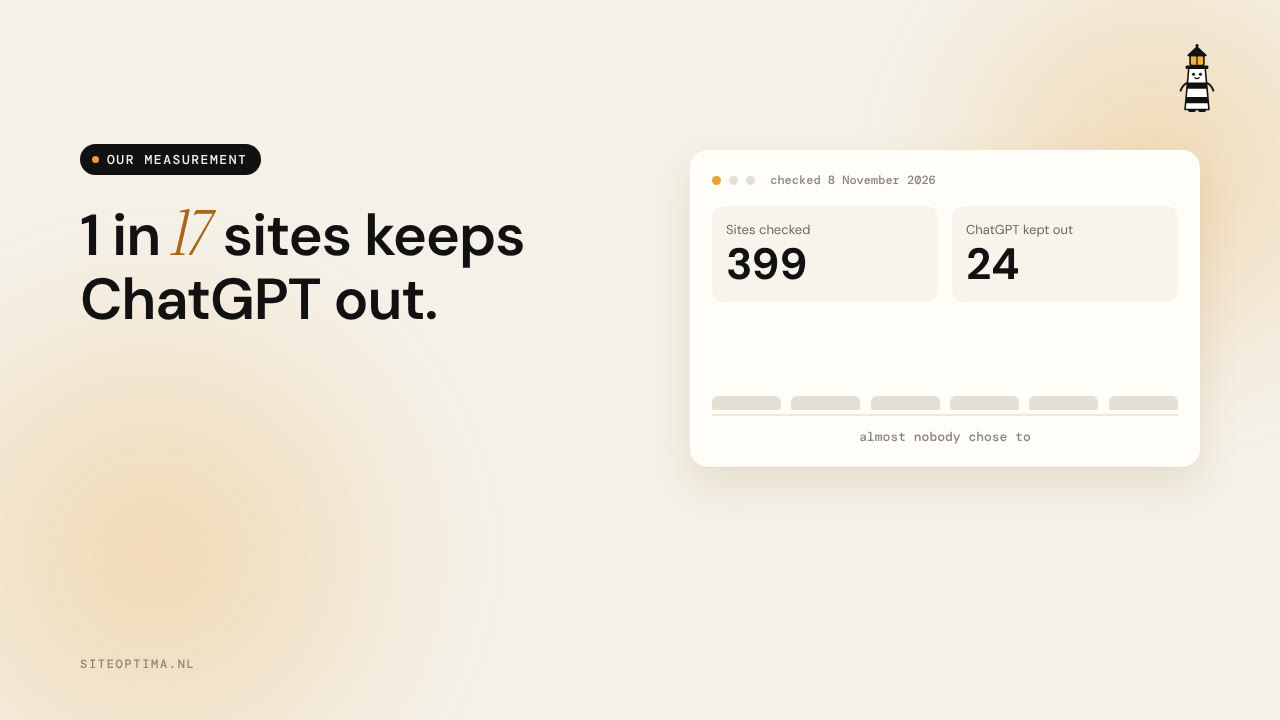
1 in 17 sites keeps ChatGPT out. Almost nobody chose to.
We checked 399 business websites around Eindhoven to see whether ChatGPT's search bot is let in. At 24 it is not. Only 2 of those name the bot: the rest shut it out with a firewall or a blanket rule. US government sites show the same pattern. Here is how to check your own site in two minutes.

The same mistake on both sides of the ocean
At the end of October an American SEO specialist published a study of the robots.txt of every US government website. Of the sites with a robots.txt, 5.2% shut out ChatGPT’s search bot while letting Google in. That is 1 in 19.
The telling part was in the second paragraph. Of the 423 sites that block the bot, 11 name it. The rest have a list of approved search engines from years ago, with a line at the bottom that keeps everything else out. Two of those templates, one from a website platform for small local governments, account for two thirds of the cases.
Nobody there decided to shut out ChatGPT. It just happened.
We wanted to know whether businesses around Eindhoven are any different.
What we measured
On 8 November 2026 we visited the websites of the businesses in our database: estate agents, opticians, builders, painters, accountants, garages, beauty salons. After leaving out sites that could not be reached, 399 remained.
For each site we looked at three things:
- The robots.txt. The file in which a site says which bots may read which pages. 366 of the 399 sites have one (92%).
- ChatGPT’s search bot. Does that robots.txt let OAI-SearchBot read the home page?
- The firewall. We requested the home page as an ordinary browser and then as OAI-SearchBot. If the browser gets in and the bot does not, something other than the robots.txt is stopping it.
1 in 17 keeps ChatGPT out
24 of the 399 sites do not let ChatGPT’s search bot in. That is 6%, 1 in 17, close to the US government figure.
A site like that cannot be a source in a ChatGPT answer. OpenAI itself says sites that block OAI-SearchBot do not appear in its search answers. When a customer asks ChatGPT for a painter in Eindhoven, ChatGPT cannot read your site to recommend you.
How those 24 are closed:
- 2 name the bot and tell it in their robots.txt to stay out. That is a deliberate choice. Nothing wrong with it.
- 2 shut it out with a blanket rule that applies to every bot.
- 20 shut it out with a firewall. Their robots.txt says nothing about ChatGPT, or even allows it. The bot is turned away only at the front door.
Just like the government sites: at 22 of the 24 nothing says anyone wanted ChatGPT out.
The firewall nobody sees
Of the 20 firewall blocks, 13 are on sites behind Cloudflare, a service that makes websites faster and safer. 11 of those look very much alike: a domain name made of a trade plus Eindhoven, the same software and the same answer to the bot. We do not know who runs them. Below we call them the group of eleven, because they weigh heavily on the numbers.
That fits how Cloudflare worked. From 1 July 2025 to 15 September 2026 Cloudflare blocked AI bots by default on every new site. Since 15 September search bots are let in by default on new sites again. A site added before then keeps the setting it had until someone changes it. On my own site it was switched on too, until I turned it off.
Behind Cloudflare, 15 of 69 sites keep ChatGPT out (22%). Without Cloudflare it is 8 of 318 (2.5%). Leave out the group of eleven and 4 of 58 remain behind Cloudflare (7%). Still more often, but that is four sites. Most of the gap comes from that one group with the same setting.
Check your own site in two minutes
- Open yourdomain.com/robots.txt in your browser. Look for OAI-SearchBot. If nothing mentions ChatGPT and there is no
Disallow: /underUser-agent: *, your robots.txt is fine. - Is your site behind Cloudflare? Ask your website builder or look in the Cloudflare dashboard under the AI crawler settings. If you want ChatGPT to be able to name you, set search bots to allow. You can keep blocking training, that is a different bot.
- Not sure? Ask your builder whether there is a firewall rule for bots. A site that works in your browser can still be closed to ChatGPT.
Blocking training and allowing search go together fine. GPTBot collects text for new models, OAI-SearchBot reads your site so it can name you. If you do not want the first, you do not have to give up the second.
Whether ChatGPT then actually names you is another question. An open door makes you readable, not chosen. We wrote about that in AI is not taking your customers.
What these numbers do not say
Our test did not come from OpenAI. We sent the bot’s name, but not from OpenAI’s servers. A firewall that blocks fake bots and lets the real one in gives us the same result. For the 20 firewall sites we therefore say: it looks closed. Your builder can know for sure.
It is not a sample. The 399 sites are businesses we researched, often because their site could be better. That does not tell you how it is for every business in Brabant.
It is one measurement. A setting can be different tomorrow. From now on we measure this every quarter in our sector research.
The Cloudflare group is small. 69 sites, 11 of them from the group that looks alike. The gap with and without Cloudflare is real, but its size says more about that group than about Cloudflare.
Choosing is fine. Not knowing is a pity.
There is nothing wrong with keeping the bots of ChatGPT or Claude out. There can be good reasons. You do not want your text to end up in an AI model, or your customers find you by word of mouth anyway. The two sites that block the bot by name made that choice. Fine.
It becomes a pity when you do not know. You run a good business, with happy customers and good reviews. A new customer asks ChatGPT for a painter in your town. ChatGPT cannot read your site, because of a setting you never chose. Your competitor gets named, you do not. Not because you are worse, but because the door was shut.
So take a look. After that it is your choice.
Sources: Josh Blackburn SEO, “AI Crawler Access Study”, crawl of 24 October 2026, published 29 October 2026 via GlobeNewswire. Cloudflare, press release “Cloudflare Just Changed How AI Crawlers Scrape the Internet at Large”, 1 July 2025, and changelog “New options to manage AI traffic”, 2026. OpenAI, documentation on OAI-SearchBot. SiteOptima, check of 399 websites on 8 November 2026.
Frequently asked questions
Is it bad to block the bots of ChatGPT or Claude?
No, as long as you do it on purpose. There can be good reasons, for instance not wanting your text to end up in an AI model. It becomes a pity when you do not know: then an AI assistant cannot recommend you, even if you run a good business with good reviews.
How do I know whether ChatGPT may read my website?
Open yourdomain.com/robots.txt and look for OAI-SearchBot, ChatGPT's search bot. If it sits under Disallow: /, or under User-agent: * without OAI-SearchBot being allowed separately, it is kept out. If your site is behind Cloudflare, also check the AI crawler settings in the dashboard. That block does not show in your robots.txt.
What is the difference between GPTBot and OAI-SearchBot?
GPTBot collects text to train AI models. OAI-SearchBot reads pages to show them as sources in ChatGPT's search answers. You can block GPTBot and allow OAI-SearchBot. Your text is then not used for training, but you can still be named.
Does Cloudflare block ChatGPT automatically?
That depends on when your site joined Cloudflare. From 1 July 2025 to 15 September 2026 Cloudflare blocked AI crawlers by default on new domains. Since 15 September 2026 search bots are allowed by default for new domains. A site added earlier may still have the old setting.
How large was your measurement?
399 business websites from our database, mostly around Eindhoven, checked on 8 November 2026. These are businesses we researched, not a random sample. Five sites would not let us test because they saw too many requests at once. We leave those out.
Curious how your website scores?
Enter your website and get a free report within minutes: how Google and AI assistants read your site and what to do about it.
Get the free report →